
back home in kaysville
Getting Home Early
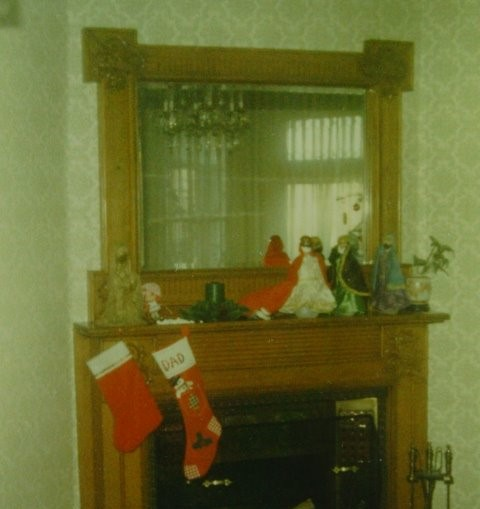
We had a three-year assignment to serve in Samoa. We returned a year and a half early. When preparing to move home early, we ran into conflict with the people we had rented our house to. Foolishly, I had drawn up an ironclad rental contract that protected us if the renters moved out of our house early, but it did not make provisions for our needing to return early. They had legal rights in the matter, and we had to rent another house while working through this conflict. Kathy became pregnant with Adam, our fourth child and third son. Eventually, the family in our home found another house. Just before Adam’s birth, we returned to our Victorian home when the other family moved out. But the conflict left us with bad feelings.
When I first returned to our downtown Kaysville home, I joined a carpool to work in Salt Lake City. The first day they picked me up, the former renter of my home was also a member of the carpool. At first, we both felt a sense of tension. On the way home a few days later, he told the group that he had a new gas dryer and didn’t have a gas hookup where he was living. He needed help setting that up. No one else volunteered to help him make the hookup, so I offered to help. While working together, we were able to discuss other topics and gradually moved to discussing our rental coflict. During the discussion, we both gained a better understanding of each other’s position. His family still lived in the ward (congregation) we had just returned to. On Sunday, we ended up sitting directly behind them at Church. When the sacrament meeting was over, we turned to each other and talked. And we became friends. They were originally from New York. We were originally from Los Angeles. We were both in Utah without family connections. We formed our own family connection and engaged in numerous activities together. We also gardened together and frequently visited each other’s homes.
Trains and Lost Paychecks
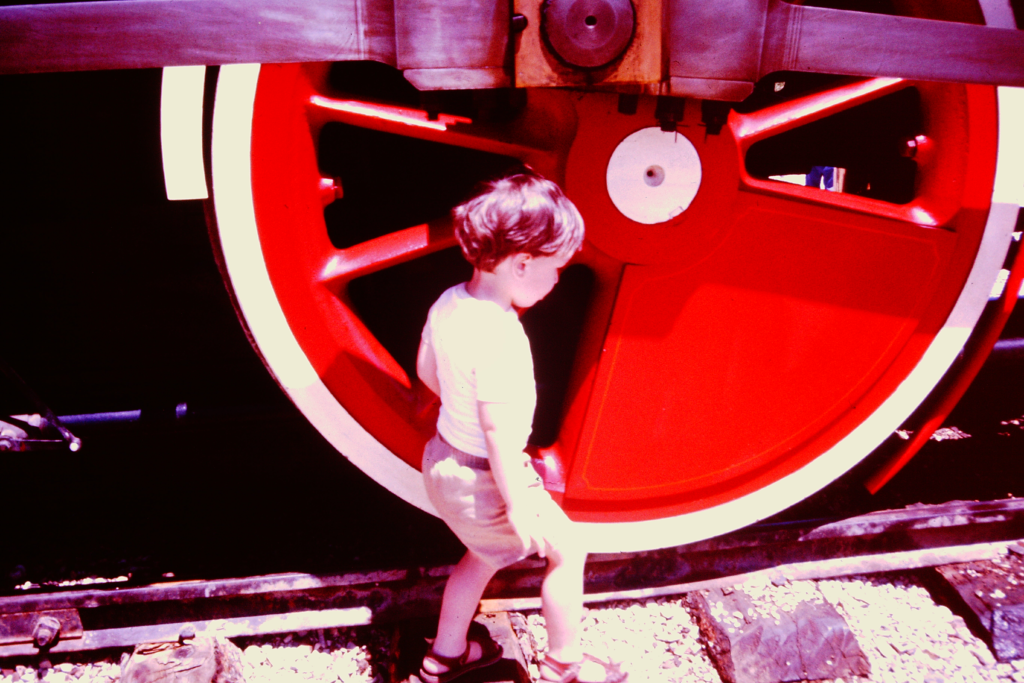
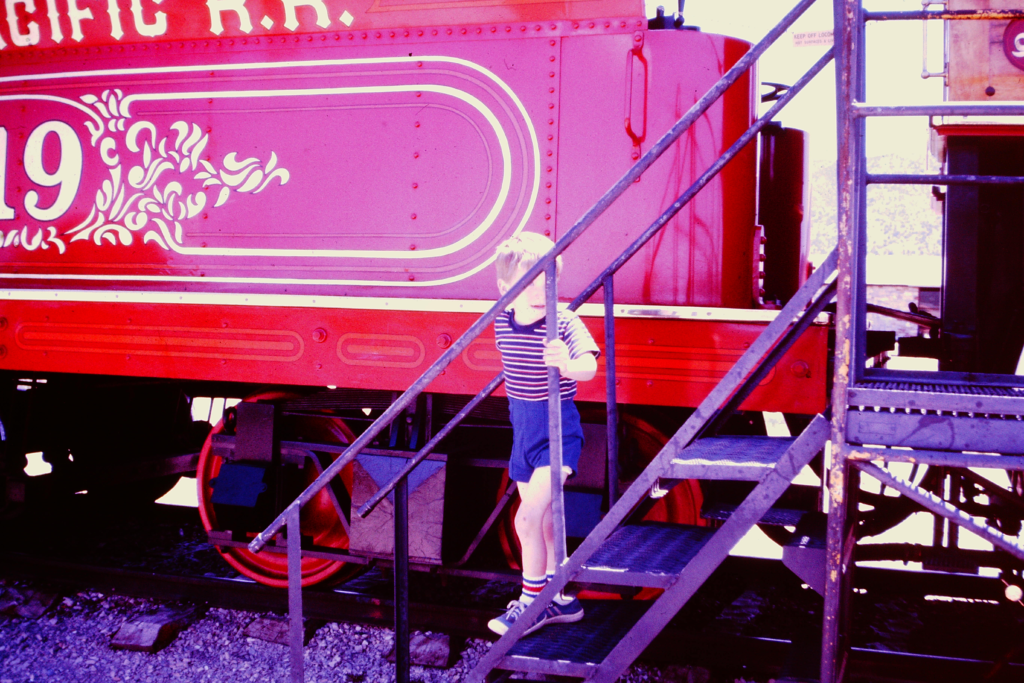
On a visit from California, my dad, a former train mechanic, took us out to Promontory Point, Utah, where we saw the connecting point between the railroads coming from the East and the West. It was a fun chance to see a piece of history. It was also fun to learn from Dad, who was an expert at steam engines. He struck up a conversation with the engineer, and we were able to see from inside how the locomotive operates. The boys loved this.
A few months into my new role as Payroll Manager, my former boss from Samoa required a special concession as he was relocating to a different country. Only the Payroll Manager could grant this favor, and he was sent to me to make the request. I’m so glad this happened because I could assess my feelings. I decided to let God, not me, judge what had happened in Samoa. For me, the best thing to do was to forgive and move on. And forgiveness felt good. And then the feelings of my service in Samoa remained sweet.
Paychecks were printed at an off-site technology center about a block away. An employee from the treasury department and I would check out a fleet car and go to the tech center and print checks. Then we used a unique signature plate to “sign” all the paychecks (thousands of them). We would then pack them up and return the car to fleet services, and we moved the checks to the treasury department for distribution. One time, the treasury representative checked the car in before I had unloaded it. I stepped a few feet away, and someone got into the car and drove off, with all the paychecks in back. He had checked the car out as soon as we checked it in. I turned around to see him driving off. He had no idea what he had as he was headed out of town. There were no cell phones then. I took the problem to my boss. He then set an example for me on how to manage a crisis. He called all his supervisors together to discuss the situation and explore everyone’s ideas on how to recover or replace the paychecks. After exploring all ideas, a recovery plan was put in place. However, the paychecks surfaced when the driver stopped outside Salt Lake City and looked inside the station wagon’s cargo area. Upon seeing so many paychecks, he immediately drove back to fleet services. Once the checks were recovered, another meeting was held to explore how to prevent this from happening again. And a procedure was implemented. There was never any effort made to point out who was at fault, only how to solve today’s problem and prevent a future problem. This has been my management style ever since. Finding blame is a waste of time.

Opportunities and Technology
While serving as Payroll Manager I was given an unusual assignment. Elder Yoshihiko Kikushi was called as a general authority seventy. Because of this assignment he was moving from his home in Japan to Salt Lake City. I was asked to meet with him weekly for several months and to help orient him to life in the United States. It was my job to help him with getting the paperwork prepared and to just be there to answer questions. Every week when I went to see him, he treated me as his honored guest. It was his privilege to see me. Once, in the hardware store, he spotted me across the store and waved to me and came over and introduced his wife and I introduced Kathy. He had become a friend. This was such a special privilege for me.
In 1983, the Church was an early adopter of direct deposit payments for its employees, particularly given the size of its payroll. A significant issue was that direct deposit would remove the check “float” experienced with paychecks. When we issue paychecks to the employees, the cash remains in Church bank accounts until the check clears, which can be weeks for some employees. With direct deposit, all of the money is removed from our bank account on payday, allowing no float time. The top leaders concluded that it was the employees’ money, and the float was a windfall to the Church. Ensuring that employees were paid promptly was the priority. Electronic funds transfers were also to be examined for other tasks, such as funding missionary living allowances and member donations. When they decided to move ahead, I oversaw promoting the program among all employees. Due to the number of employees residing outside of Utah, direct deposit was a good idea as it alleviated some pressure on delivering paychecks on time worldwide. If a direct deposit slip did not reach the employee quickly enough, the employee still received payment on time. He just didn’t have the pay stub until it was delivered. The goal was to achieve a 70% employee participation rate. I made presentations to many employee groups in Salt Lake City, typically a few hundred employees at a time. I put together flyers for those outside SLC. Participation quickly surpassed 70% and eventually passed the 90% range. I would imagine it is near 100% today. And the leaders began to explore other electronic funds transfer applications. I reported progress on a weekly basis, using charts and graphs. It was great to be a part of starting something so new. And who doesn’t choose direct deposit now?
Mom’s Passing
In 1984, my mother passed away. Dad, at 77, was serving as bishop of a singles’ ward when she was diagnosed with cancer. The breast cancer was successfully removed, but new symptoms emerged just weeks later, and she was diagnosed with a malignant brain tumor. She and Dad decided to serve in the singles’ ward to her end. A few weeks later, she unexpectedly developed a respiratory infection, which took her life. Upon knowing she was in the hospital, we began driving to Lakewood Friday after work in Salt Lake City. I arrived at the hospital’s front door early Saturday morning. They called her room and announced my arrival, and I went up to her room. She passed away after the call to her room, but before I got to her room. I believe she held on until I was there to be with Dad. I am convinced the respiratory infection was a blessing, so she would not have to face future deterioration with brain cancer.
When she went into the hospital, she was given a blessing by Dad and the stake president, with the president acting as spokesman. According to Dad, he blessed her that she would live to continue her work in genealogy. She loved genealogy and spent hours researching. My dad went to bed that night but had an extremely restless night. He awoke with the impression that they had given Mom the wrong blessing. In the morning, he called the stake president and asked that they go back. They then gave her a new blessing, promising her peace as she entered a new world. And she passed the next morning.
The stake president spoke at her funeral. In his talk, he mentioned that her future was to work on genealogy on the other side of the veil, rather than this side. He said, “Now that the lights are out in her own room, she will be able to see more, know, and meet more ancestors. Now she will be able to direct those here to the proper records. Those who have survived her must continue with her desire, for she will inspire, bless, and help.”
Moving On
We had begun planning to construct a solar-heated home in Alpine, Utah. This was a very early energy-efficient design. The plans were drawn up, but life took us in another direction before we could close on the lot. Kathy’s mother and my father were both alone now and were having health problems. Dad had fallen once and was on the floor for two days before being discovered. We decided we should move to Southern California to be closer. This was a career sacrifice because I was being groomed to run the entire Church accounting system at the time. My bosses were very disappointed when I requested the move. (I still wonder if I made the right decision.)
The story of Kathy & Ron Goodlad
© 2025 The Goodlads